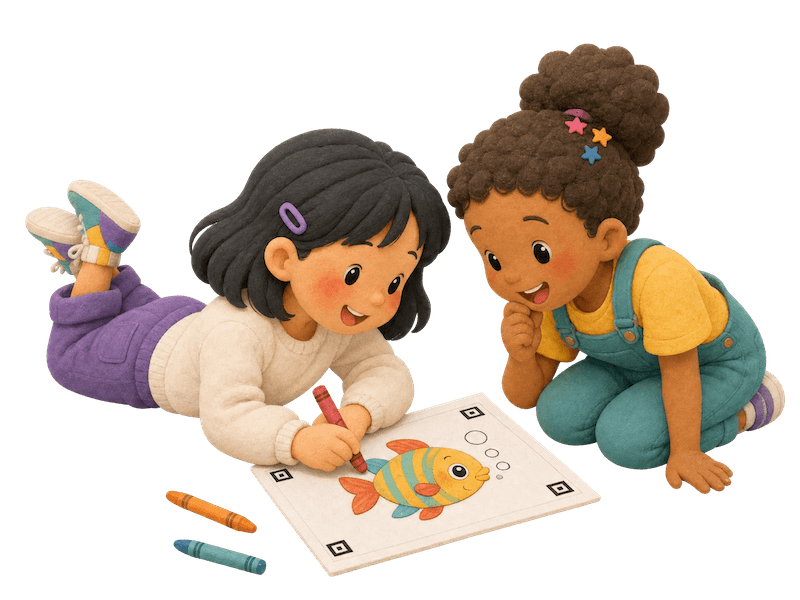
Every coloring page ends the same way. A kid works at one for twenty minutes, hands it over, and waits for the verdict. You say it's beautiful, because it is. It goes on the fridge. Three weeks later it goes in the recycling while nobody's looking.
That isn't sad. It's what paper does. It is, though, the reason we drew these particular fish.
Twenty-three sheets, and what's on them
They're free to download. No account, no email address, no newsletter waiting on the other side of the button. Each sheet is one creature on a landscape A4 page, drawn with thick lines and wide open spaces. A three-year-old can fill one with a fat crayon and no precision at all. A nine-year-old can get fussy about the fins.
Fifteen of them are fish: clownfish, angelfish, betta, goldfish, guppy, parrotfish, pufferfish, damselfish, discus, cowfish, butterflyfish, snapper, tang, triggerfish, grouper. Then the big ones, a shark and a whale and a manta ray. Then a seahorse, a sea turtle, a crab, a jellyfish, and a mermaid for the household where the mermaid is non-negotiable.
A blank sheet is on the way as well, for the kid who wants to invent something that doesn't exist yet. It isn't ready.
Which one to print first
Twenty-three is too many to choose from at eight in the morning, so: for the youngest, print the whale or the crab. Big shapes, few internal lines, hard to get wrong, finished before anyone loses interest.
For a five- or six-year-old, the clownfish. It's the one they can name, the stripes give the page some structure, and there's enough room in the fins to experiment.
For an older kid who actually wants a project, print the betta or the parrotfish. Both are cut into a lot of small separate regions, which is an invitation to use every color in the tin, and they take a good half hour.
Print at 100%
This is the one setting worth checking. Your print dialog probably defaults to "fit to page" or "shrink to printable area". Turn it off and print at actual size.
Each sheet has four small black-and-white squares in its corners. They look like decoration. They're how a phone camera later works out where the page is, how far it's tilted, and which creature it's looking at. Printed at full size they stay square and readable, which is all they need to be.
Plain printer paper is fine. Skip anything glossy — crayon skids across it and never quite covers.
Crayons beat pencils, slightly
Almost anything works. Crayons, markers, colored pencils, the dried-out set living in the bottom of the bag. But if the fish is going to end up on a screen, bold beats delicate. Colored pencil pressed lightly photographs pale, and it'll be just as pale swimming around afterward. Marker is the safe bet. Crayon has more texture and looks more like a child made it, which is the point.
Going outside the lines is fine too. When the drawing gets lifted off the page it gets cut to the shape of the creature, so the stray orange scribble across the background stays behind on the paper.
And then they swim
This is the part that isn't like other coloring pages. When the fish is finished, open your tank on whatever screen is around — the television is the good one — and hold the page up to the camera. The drawing comes off the paper and swims into the reef. Crooked eye, purple stripe, all of it.
The first five are free and don't need an account. How it works covers the rest of it.
For a party or a classroom
Print a stack. Twelve kids at a table with twelve different fish will stay quiet for longer than anyone at that table expects, and when they're done all twelve fish end up in the same reef on the same screen. Everyone finds theirs immediately. Nobody argues about whose is best, because they're all in there together, swimming past each other.
It works the same way for a class. One tank, thirty sheets, and a smartboard at the front already pointed at the room.
The page still goes in the recycling
Eventually it does, and that's fine. It's paper. The difference is that by the time it gets there the fish has been somewhere — it swam across the living room while somebody's grandmother watched, and the kid who drew it got to point at the television and say that one's mine.
Print one and see how it goes.