Play Magic Reef has won a Gold award at the 2026 w3 Awards, one of the longest-running awards for websites and digital work. It won in the Children & Youth website category, and it was the only Gold given out in that category this year.
Who else won
Three other projects won in the same category. All three earned Silver:
- An interactive American Revolution lesson for PBS LearningMedia, part of its Ken Burns classroom collection
- An energy education curriculum for Alliant Energy, a utility company
- A dig-safety game for 811, the call-before-you-dig hotline
All three were made by d'Vinci Interactive, a company that has built educational software for more than 30 years, for clients like PBS and National Geographic.
Play Magic Reef was made by one person. On the official award listing, the "Team" field has a single name: Eugene Lee.
What the w3 Awards are
The w3 Awards started in 2005, and this was their 21st year. They honor the best work on the web, including websites, apps, videos and podcasts. They receive thousands of entries every year from around the world.
The judges come from the Academy of Interactive and Visual Arts, a group of professionals from places like Google, Netflix, Microsoft, Disney, the Smithsonian and Stanford. This year's winners also include Bank of America, Cisco, Pfizer, BBC StoryWorks and the J. Paul Getty Trust.
How the judging works
Entries aren't judged head to head. Each one is scored out of 10 by several judges, and the scores are averaged. An average of about 9 or higher earns Gold. Scores from 7 to 8.9 earn Silver.
Every project in our category was scored by the same jury against the same standard, and Play Magic Reef was the only one to reach Gold. The PBS project and the other two received Silver.
To be clear, the PBS lesson is good work. It follows a girl named Betsy Ambler through the Revolutionary War, and it's made for students in grades 3 to 8. Seeing Play Magic Reef score higher than a project like that was a real surprise.
What Play Magic Reef does
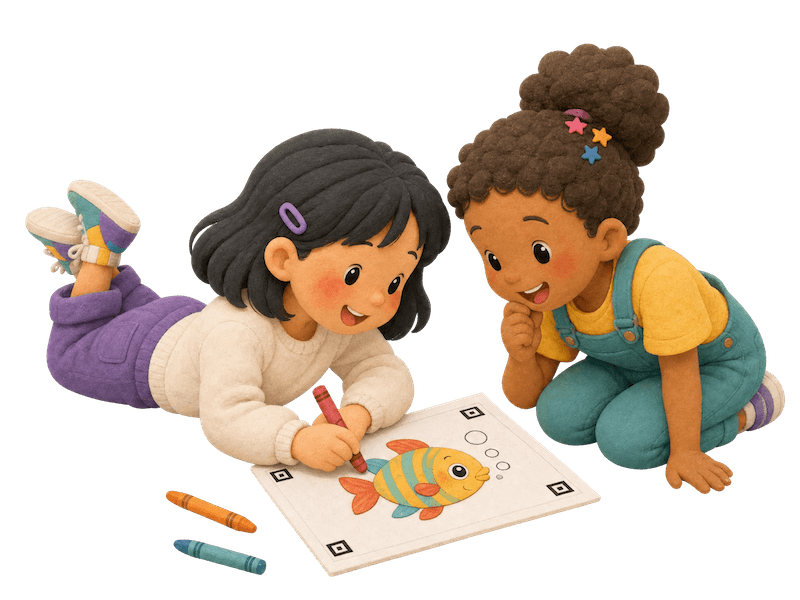
If you're new here: Play Magic Reef is a website where kids color a fish, on paper or on a tablet, and then watch it swim into a live reef on the TV. There's no app to download. Every family's reef is private, kids don't need an account, and there's no chat and no strangers. You can read more about how it works.
Why this one means a lot
I've been building websites and interactive projects for more than 20 years, mostly at agencies, for big brands. Play Magic Reef is different. It started as a gift for my two nieces in Chicago, after we visited an aquarium where you color a fish and it appears on a giant screen. They loved it, but I live in Paris, so we couldn't just go back. So I built them a reef they could play with at home. You can read the full story here.
It's still a one-person project, with no studio and no investors behind it. Winning Gold in a category alongside a 30-year-old company and a project for PBS means a lot to me.
Thank you
Thank you to the w3 judges for their time. Thank you to every family who has set up a reef and handed their kids the crayons. And thank you to the kids, whose drawings fill every tank.
If you haven't tried it yet, start a reef and let your kids draw the first fish.